
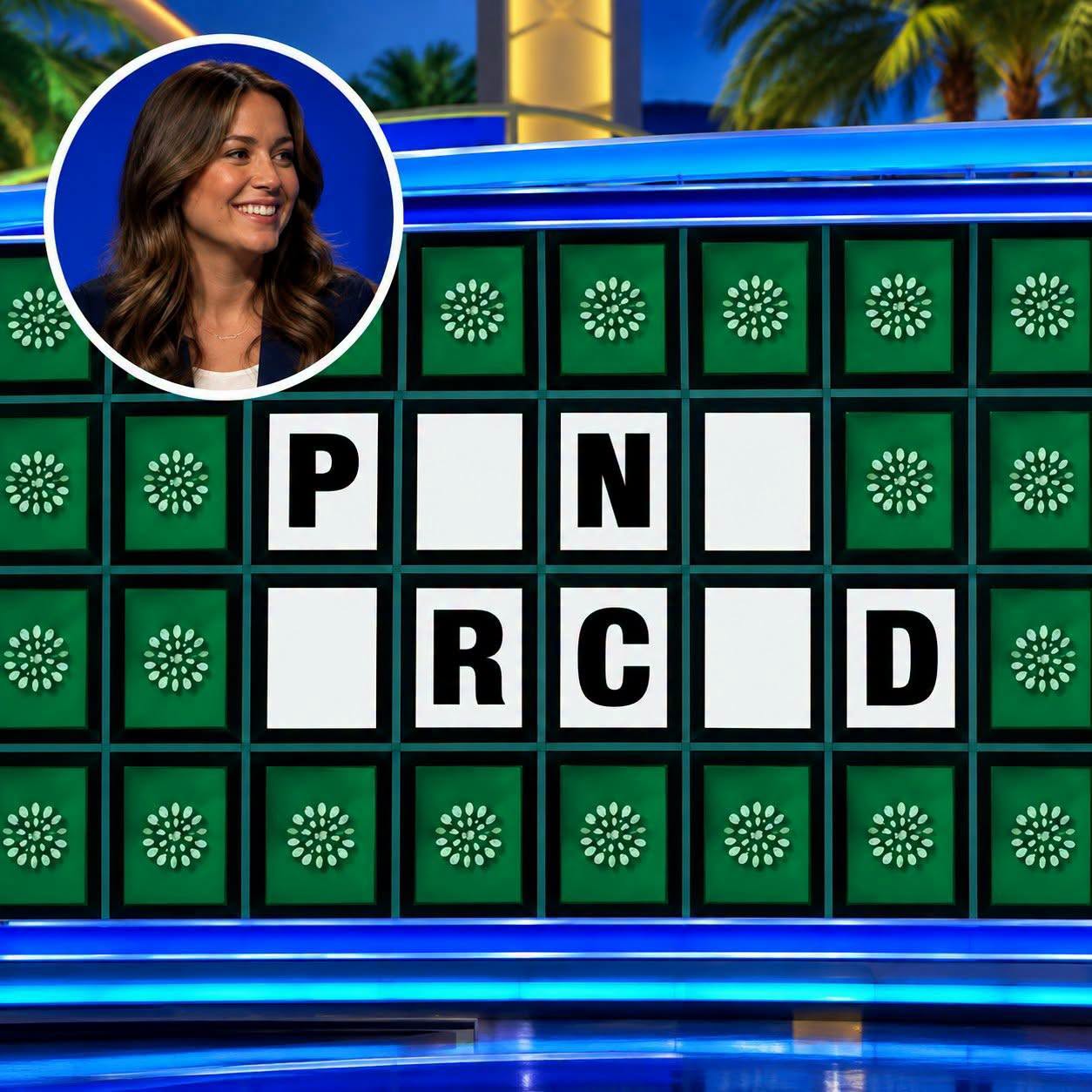
A single word brought what appeared to be a winning game-show moment to an unexpected end. Millions of viewers believed Megan had given the correct answer, but the judges disagreed. What seemed like a straightforward victory quickly became a topic of discussion, as viewers questioned whether the response had been pronounced accurately enough to satisfy the rules.
Megan’s turn began with the usual pressure of the game. She spun the wheel, called letters, and gradually revealed the puzzle on the board. As more of the phrase appeared, her confidence grew. The solution seemed increasingly clear, creating the kind of tense moment contestants hope will lead to a successful finish.
When Megan finally gave her answer, many viewers believed it matched the puzzle. However, the judges focused on the way the phrase was pronounced and determined that it did not meet the required standard. The buzzer ended the attempt, changing what had seemed like a successful conclusion into an unsuccessful answer before the game continued.
The decision prompted considerable discussion among viewers after the episode. Clips were replayed, and people debated whether Megan had clearly solved the puzzle or whether the rules required a more precise pronunciation. Some felt the answer should have been accepted, while others noted that game shows often depend on exact wording and established rules. The moment ultimately demonstrated how a small difference in pronunciation can have a significant effect during a high-pressure competition.
A story circulating online has attracted attention because of an unusual claim involving a family, but the version being shared leaves several important questions unanswered. The account does not clearly identify where the reported events supposedly occurred, and it provides limited information that would allow readers to independently confirm the details. Without a clear location or reliable sources, it is difficult to establish whether the story is connected to a documented report.
The article refers generally to authorities, medical professionals, and social services, but does not identify specific agencies or provide verifiable statements from them. Mentioning official-sounding organizations alone does not establish that they confirmed the events described. Reliable reporting should provide enough context for readers to distinguish documented information from claims that have simply been repeated online. This is particularly important when stories involve private families or children.
Another concern is how quickly emotionally engaging stories can spread. A dramatic headline may encourage sharing before readers check the available evidence, while repeated posts can create the impression that a claim has been independently confirmed. Popularity, however, does not establish accuracy. Readers may also begin filling missing details by guessing the location, identities, or actions of authorities, creating additional claims that were never included in the original material.
The most responsible approach is therefore to acknowledge the limits of the available information. The circulating account does not provide enough identifiable evidence to establish every detail it describes. Readers should look for independent confirmation, identifiable sources, and clear context before treating unusual claims as established facts. This approach also helps protect private individuals from unnecessary speculation. Until reliable evidence becomes available, the story is best regarded as insufficiently documented rather than confirmed.
At first glance, the black-and-white illustration appears to show a peaceful forest scene featuring raccoons, trees, rocks, and a small stream. However, hidden among these familiar details is a cleverly disguised bird. The drawing uses detailed lines and natural shapes to make the challenge less obvious, encouraging viewers to look beyond the main subjects.
The hidden bird is difficult to notice because it blends into the surrounding scenery. The artist uses shadows, patterns, and carefully placed lines to make the shape appear like another part of the forest. Since the eyes naturally focus on recognizable objects such as animals and tree trunks, the hidden figure can easily be overlooked.
Finding the bird requires a slower and more careful approach. Instead of concentrating only on the raccoons or other prominent features, examine the entire illustration from different angles. Pay particular attention to unusual spaces, edges, patterns, and areas where the lines or shapes appear slightly different from the surrounding details. Changing your focus can sometimes make the hidden form easier to recognize.
The challenge is designed to test patience and observation rather than speed alone. Some viewers may notice the bird quickly, while others may need several minutes of careful searching. Take your time and scan the image from top to bottom, looking closely at both the obvious subjects and the less noticeable background details. The hidden shape may become easier to identify once you stop focusing only on the main elements.
In the quiet town of Oakhaven, the marriage of Ethan and Margaret attracted attention because of their different backgrounds and ages. Ethan was a younger man who had recently settled in the community, while Margaret was a respected widow known for her generosity and charitable work. Despite local speculation, Margaret believed their relationship offered genuine companionship and looked forward to building a meaningful future together.
After the wedding, the couple appeared to enjoy a peaceful life. They shared meals, walked through Margaret’s gardens, and discussed their plans for the future. However, while organizing a room one morning, Margaret discovered personal correspondence Ethan had left behind. The documents raised concerns about whether his intentions matched the sincere commitment she believed they shared, leaving her disappointed and uncertain about their relationship.
Rather than making an immediate decision, Margaret took time to consider her options carefully. She sought guidance from trusted professional advisors who had helped her manage important personal and financial matters. With their assistance, she reviewed her arrangements, updated documents where necessary, and took practical steps to protect the future she had worked to build. Although she was hurt by what she discovered, Margaret remained focused on making thoughtful decisions.
Eventually, Margaret decided to leave Oakhaven temporarily and spend time at a peaceful coastal retreat. Before departing, she left a brief message reflecting on the importance of honesty, trust, and mutual respect in lasting relationships. Ethan was left to consider the consequences of the broken trust, while Margaret focused on moving forward. The experience became a reminder that difficult personal circumstances can also encourage reflection, resilience, and a renewed commitment to one’s values.
Christa Pike’s long-running Tennessee legal case has continued to attract attention as her attorneys pursue additional legal options. The case began after events involving Pike during her time as a young participant in a Job Corps program in Tennessee and has developed through years of court proceedings, legal reviews, appeals, and petitions seeking further consideration.
A central part of the arguments presented by Pike’s legal representatives concerns her personal history. Her attorneys have maintained that experiences from her childhood and teenage years should be considered when reviewing her circumstances and the events that eventually brought her into the Tennessee legal system. They have also requested certain accommodations during the latest stage of the proceedings, arguing that these could provide greater consideration of her background and reduce emotional distress.
Because the case has continued for many years, numerous legal and administrative steps have been involved. Different arguments, records, petitions, and requests may require review by courts or state officials before decisions are made. The case has also remained significant for people connected to the original proceedings, as long-running legal matters can continue to affect families and communities well after the initial events.
Pike’s representatives continue to pursue the options available through the legal process, while relevant authorities remain responsible for reviewing the requests and determining the next steps. Future developments may come through court records, official statements, or announcements from the parties involved. Given the case’s lengthy history, readers following it should consider individual claims within the broader legal record and rely on identifiable official sources when evaluating new information.
People often talk about how relationships end, but departures are not always obvious. Sometimes there is no argument or final goodbye. Instead, distance gradually grows until someone who once felt like a permanent part of life becomes a memory. Only later do you realize how quietly the relationship changed and how difficult it can be to identify the exact moment it happened.
The idea of choosing a chair can represent something deeper: deciding where you feel valued, understood, and supported. One chair may belong to someone who has known you through different stages of life and remained present during difficult moments. Their support may not always be dramatic or visible, but their consistency can become meaningful over time. Another chair represents someone who continues to choose the relationship each day, sharing challenges, growth, and ordinary experiences.
The final chair represents a different kind of relationship: the one you have with yourself. Sitting there can mean recognizing how often you have chased approval, waited for someone to change, or continued investing in situations where you did not feel appreciated. It can also mean accepting that being alone does not necessarily mean being without support, purpose, or value.
With that realization, solitude can take on a different meaning. Instead of constantly trying to earn a place where you are not valued, you can step back and focus on your own well-being and priorities. Sometimes the strongest form of loyalty begins with remaining true to yourself. Learning to enjoy your own company can create a sense of peace that does not depend entirely on who chooses to stay.
What began as an ordinary afternoon at a busy department store in northern Mexico City unexpectedly attracted attention after a disturbance near a fitting-room area drew interest from shoppers, employees, and security personnel. Employees reportedly noticed unusual activity and checked the area while continuing to maintain a comfortable environment for customers. Although there was no immediate indication that most shoppers were in danger, the disruption soon became noticeable to people nearby.
According to accounts shared by witnesses, employees attempted to manage the situation calmly while protecting customer privacy. As curiosity grew, some shoppers gathered nearby and began recording with their phones. Security personnel were called to help maintain order, keep walkways clear, and encourage people to move away from the area. The arrival of additional individuals connected to those involved reportedly contributed to a tense atmosphere, while staff continued working to minimize the disruption.
Local authorities were reportedly contacted so the circumstances could be documented and assessed. However, information shared online may not provide a complete account of what happened. Witness reports, short videos, and social media comments can leave out important details or present events without their full context. Any questions concerning possible violations of local rules or regulations would need to be addressed by the appropriate authorities based on available evidence.
Although the situation eventually returned to normal, videos and comments continued circulating online. The incident highlighted how quickly a relatively limited event can attract widespread attention when smartphones are involved. It also serves as a reminder that businesses need clear procedures for unexpected disruptions, while shoppers can help by avoiding unnecessary crowding and respecting privacy. Online viewers should likewise consider the limitations of short recordings and unverified accounts before drawing conclusions about an incident.
Erika Kirk has addressed recent online reports involving her and Blake Wynn after claims about their personal connection began circulating on social media. The reports generated discussion online, but Erika stated that the information being shared was inaccurate. She also clarified where she was at the time referenced in the reports, explaining that she was with her family.
Erika further explained that Blake Wynn was a friend of her late husband, Charlie Kirk, and that his connection with the family came through that existing friendship and continued support. Wynn also responded to the reports and rejected the claims being circulated about his relationship with Erika. Their public statements provide additional context for understanding the situation and separating direct statements from online speculation.
The episode illustrates how quickly unverified personal claims can spread across social media. Information may be repeated by multiple accounts without becoming independently verified, while headlines and short posts can leave out important context. For this reason, readers should consider statements from the people directly involved and distinguish confirmed information from claims that remain disputed or unsupported.
In this case, the individuals involved have publicly rejected the reports, so the claims should not be presented as established facts. Erika has continued focusing on her family and public responsibilities, while the discussion highlights the importance of handling personal information carefully. Until reliable evidence or additional verified information becomes available, readers should rely on direct statements and identifiable sources rather than assumptions or repeated social media speculation.
At first glance, the property appears to be an attractive opportunity, with a cozy green exterior, a quiet yard, three bedrooms, and two bathrooms listed for $20,000. With housing costs continuing to concern many buyers, such a low price can naturally attract attention and create expectations of an affordable traditional home.
However, the listing contains an important detail that can significantly change how the property should be understood. What may initially appear to be a conventional house is actually a mobile home. If that information is not clearly presented at the beginning of the advertisement, potential buyers may form an inaccurate impression about what is being offered and why the price is so low.
The difference matters because a mobile home can involve different ownership arrangements, financing considerations, property rules, and ongoing costs compared with a traditional house. Simply highlighting the number of bedrooms, bathrooms, and the purchase price does not provide enough information for someone to evaluate the opportunity. Buyers need to understand the type of property and the conditions connected to the sale before making assumptions about its value.
The listing serves as a reminder to look beyond an attractive headline or unusually low price. A detailed description should clearly explain what is being sold and provide relevant information that allows potential buyers to make informed decisions. For anyone considering an inexpensive property, checking the full listing, ownership details, location, fees, and other conditions can help prevent misunderstandings and unexpected surprises later.
Two days before seventh grade, twelve-year-old Noah told his mother he was not coming home after spending the summer with his father, Matt, and stepmother, Jessica. He said Jessica was better and that they could be a real family, leaving his mother confused and concerned. Noah had normally lived with his mother, following familiar routines such as Friday pizza, Sunday pancakes, and notes in his lunch. His sudden change suggested that something had influenced his decision.
When his mother went to Matt’s house, she overheard Jessica discussing how difficult it was when Noah left each weekend and how unhappy Matt became afterward. She eventually realized that Noah had been drawn into an adult issue. Jessica had apparently made him believe that staying with his father would make Matt happier. Noah confirmed that he thought his father needed him, so his mother explained that loving a parent did not mean being responsible for that parent’s emotions.
Rather than immediately treating Noah’s decision as something to fight, she asked him to explain what he believed would happen if he returned home. Noah shared what Jessica had told him, allowing the adults to understand how he had interpreted the situation. His mother reminded him that adults are responsible for handling their own feelings and that he was allowed to love both parents.
Matt acknowledged that he enjoyed feeling needed and had failed to correct Noah’s misunderstanding, while Jessica admitted she had been trying to strengthen her marriage by keeping Noah close. The adults agreed that Noah should not be placed in the middle of their relationship. His school and regular routine would remain stable, while additional time with his father could be discussed appropriately. When Noah later asked about their Friday pizza tradition, his mother reassured him that it would continue, emphasizing that caring for family did not mean carrying responsibilities that belonged to adults.



0 commentaires:
Enregistrer un commentaire